Videi
Videi Installation
 Catalogues
 Downloads
 Opis
Opis

Solarni paneli sve se više dizajniraju imajući na umu njihovu arhitektonsku integraciju. Solarni crjepovi savršeno su rješenje budući da predstavljaju niz aktivnih tehnoloških stakala koja imaju svojstvo generiranja električne energije i mogu se koristiti kako u novoizgrađenim zgradama tako iu renovacijama.
Arhitektonska integracija fotonaponskih crijepova u građevinarstvu omogućuje stvaranje ostakljenih površina koje osim što su estetska i funkcionalna novost, generiraju električnu energiju, poboljšavaju toplinsku i zvučnu izolaciju zgrada, također omogućuju kontrolu solarne i električne autonomije s posljedičnim ušteda energije.
Solar Innova nudi proizvode i rješenja prilagođena potrebama građevinskog sektora i uključuje dizajn u solarnu energiju, dajući arhitektima i inženjerima mogućnost kombiniranja fotonaponske instalacije s estetikom zgrade.
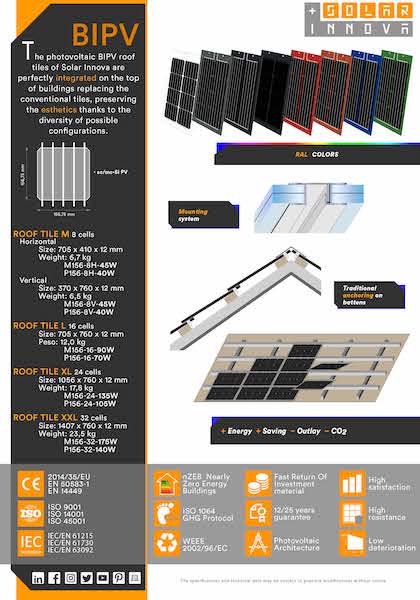
Fotonaponske ploče Solar Innova mogu se postavljati na kose krovove, zamjenjujući konvencionalne ravne ili zakrivljene ploče bez potrebe za mijenjanjem letvi. Postavljeni su s okomitim preklapanjem i pomoću samoreznih vijaka od nehrđajućeg čelika.
Ovakva rješenja savršena su za korištenje u urbanim sredinama, zadržavajući estetiku i poštujući povijesnu vrijednost okoliša.
Naše pločice ispunjavaju sve sigurnosne zahtjeve, kako za fleksibilnost, dvostruku izolaciju, tako i za visoku otpornost na UV zrake, vrlo dugu izdržljivost jer nemaju elemente koji se degradiraju pod utjecajem vremenskih i/ili okolišnih uvjeta, za sve to su idealni za korištenje u vanjskim aplikacijama.
 Materials
Solar Innova uses the latest materials to manufacture photovoltaic modules:
Glass

The front of the module contains a tempered solar glass with high transparency with high transmissivity, low reflectivity and low iron content.
The glass forms the front end of photovoltaic module and protects components housed within the laminate from the weather and mechanical stresses.
At the same time serves as carrier material in the lamination process.
A high transmittance increases the efficiency of the photovoltaic cells and thus has a direct influence on the potency and performance of the final module. A low iron content in the glass composition and an antireflection coating to reduce absorption of radiant energy.
Achieve excellent resistance against mechanical stress and temperature changes due to preload producer.
Top Encapsulant (EVA)

The sheets of EVA (Ethyl Vinyl Acetate) are used to connect the solar cells through the lamination process with glass surface. This step provides the "encapsulated" solar module that is responsible for holding together the photovoltaic module and have a decisive bearing on life. The degree of chained EVA sheet after the lamination process is decisive for the quality indicator of the solar module.
An EVA sheet must guarantee insulation and protective effect throughout the life of the module. The films of poor quality can cause long-term discoloration, delamination or decomposition and, therefore, strongly impair the performance capability of the module in question. Solar Innova uses only high quality sheet of chains with a degree exceeding 85 %, thus providing long lasting protection of cells.
|
TEST |
RESULT |
|
Light Transmittance |
≥ 91 % |
|
Water Absorption (20º C, 24 h) |
≤ 0.1 % |
|
Gel Content |
≥ 85 % |
|
Peeling strength (N/cm): EVA/Glass |
≥ 50 N/cm |
|
Ultraviolet Aging Resistance (1000 h, 83º C, 1000 W Ultraviolet Lamp) |
△ YI ≤ 2 |
|
Heat Aging Resistance (1000 h, 85º C) |
△ YI ≤ 2 |
|
Damp-Heat Aging Resistance (1000 h, 85% Relative Humidity, 85º C) |
△ YI ≤ 2 |
Cells


Solar cells directly convert sunlight into direct current electrical energy and the generator are of the module. The quality of cells directly influences the characteristics of a solar module is therefore essential silicon composition used.
Solar Innova cells used exclusively Innova highly efficient with minimal variations in the process of optimizing the production reproducibility of the separation of cells. Is a determining factor for the quality of the cell constant for stable profits. The high resistance multipliers and fill factors used cells provide a good source of energy radiation especially low.
Each cell is checked, and classified electrically calibrated prior to interconnection to optimize the behavior of the module.
Lower Encapsulant (EVA)
The sheets of EVA (Ethyl Vinyl Acetate) are used to connect the solar cells through the lamination process with glass surface. This step provides the "encapsulated" solar module that is responsible for holding together the photovoltaic module and have a decisive bearing on life. The degree of chained EVA sheet after the lamination process is decisive for the quality indicator of the solar module.
An EVA sheet must guarantee insulation and protective effect throughout the life of the module. The films of poor quality can cause long-term discoloration, delamination or decomposition and, therefore, strongly impair the performance capability of the module in question. Solar Innova uses only high quality sheet of chains with a degree exceeding 85 %, thus providing long lasting protection of cells.
|
ENSAYO |
RESULTADO |
|
Light Transmittance |
≥ 91 % |
|
Water Absorption (20º C, 24 h) |
≤ 0.1 % |
|
Gel Content |
≥ 85 % |
|
Peeling strength (N/cm): EVA/Glass |
≥ 50 N/cm |
|
Ultraviolet Aging Resistance (1000 h, 83º C, 1000 W Ultraviolet Lamp) |
△ YI ≤ 2 |
|
Heat Aging Resistance (1000 h, 85º C) |
△ YI ≤ 2 |
|
Damp-Heat Aging Resistance (1000 h, 85% Relative Humidity, 85º C) |
△ YI ≤ 2 |
Back-Sheet (TPT)

TPT backsheet is composed of a plastic polymer trilayer laminated between two layers of polyester sheet of Tedlar. Provides complete protection and sealed against environmental agents and offers a perfect electrical insulation due to its excellent strength and barrier properties against moisture and UV resistance. It also reduces the operating temperature of the cells.
Junction Box

The primary function is to transmit the energy produced in the module.
The junction box installed is made high temperature resistant plastics. The box is sealed and ready for the weather. Has a degree IP-65, which provides the insulation system against moisture, inclement weather, dirt and ultraviolet radiation. Inside are installed bypass diodes.
Bypass diodes protect the tensile modulus increased and consequently the so-called hot spot effects.
The modules are supplied with box and bypass diodes integrated.
In each module there is a single box for both terminals. Polarity must be observed in the connections to the proper functioning of the modules.
The junction box can be opened in case of failure, thereby facilitating an eventual replacement of damaged diodes. Covers of junction boxes have an indicative drawing. They open by inserting a screwdriver in the appropriate tab in the direction of the arrow, with light pressure on it to open. To close the lid, simply press it to closure. The lid has a flange attached to the junction box while handling the interior thereof. This flange must not be cut at all.
The junction boxes should not suffer any pressure when installing the module on a support structure. No element of it should touch the box.
The junction boxes are similar to modules with the same voltage rating. All connection boxes are provided with symmetrical cables of length 900 mm. With a connector positive (+) and a negative connector (-) with a working temperature range between - 40 ~ + 85° C.
Diodes

The shading of a cell can cause a reverse voltage on it. This cell thus consume power generated by the other in series, resulting in undesirable heating of the shaded cell. This effect, called hot spot will be greater the higher the radiation incident on the rest of the smaller cells and cell receiving that due to the shadow. In an extreme case the cell may be broken due to overheating.
The use of protective diodes or by-pass reduces the risk of heating of the shaded cells, limiting the current that can flow through them and thus preventing the breakage thereof.
All modules with a number of cells greater than or equal to 33 connected in series, manufactured by Solar Innova, are provided with protection diodes that are located at the junction boxes. In modules with fewer cells in series are not required the bypass diodes, as the hot spot effect does not reach the level of risk of rupture of the cells.
The replacement of bypass diodes should be performed only by a qualified competent photovoltaic after disconnecting the system module.
Cables

Our modules are fitted with flexible cables, symmetrical in length, with a diameter of copper section of 4 mm, weather resistant and have been specially designed and certified for use in our modules. Have high values of electrical safety and fire resistance. Its insulation to weathering and UV rays ensures longevity of the installation. Furthermore, the wide range of temperature allows its application even in extreme climatic areas, preventing heat aging and therefore allowing a long life in the photovoltaic system. They have a high strength and a very low contact resistance, all designed to obtain minimum voltage drop losses and allows them to continue operating even in unfavorable conditions.
All our photovoltaic modules are supplied with cable assemblies in the box with the following features:
Length: 900 mm.
Operating Temperature Range: - 40 ~ + 90° C.
Connectors

Our PV modules are equipped with connectors and sockets MC-T4 100 % compatible with the connectors and sockets used to connect electrical systems. Only MC-T4 connector or compatible and special solar cables may be used to lengthen the cables connected to the module. These must meet the electrical requirements of the Interconnection design.
All our photovoltaic modules are supplied with assembled connectors on cables with the following features:
Diameter: Ø 4 mm.
Maximum rated current: 30 A.
Maximum system voltage: 1000 V.
Plugged Protection level: IP-67.
Mounting: easy.
Locking system: Snap in.
Protection Class: II.
Operating Temperature Range: - 40 ~ + 90° C.
Sealed

PV modules require the use of silicone sealant high quality for bonding and sealing of junction boxes of photovoltaic modules.
Silicone has excellent adhesion to most substrates used in the manufacture of photovoltaic modules and does not lose its flexibility in a wide temperature range so it offers perfect protection against the ingress of water into the laminate.
Fabricated with high efficiency. No chemical reactions with EVA material and PVF film protector ensures the chemical stability.
The silicone is applied in the grooves of the frame and the edge of the laminate so as to prevent any infiltration of gas or liquid that can erode the module. At the same time, elasticity serves as a protection against possible mechanical impacts during installation or handling.
Labels

This document describes data sheet and nameplate information for non-concentrating photovoltaic modules. The intent is to provide minimum information required to configure a safe and optimal system with photovoltaic modules. In this context, data sheet information is a technical description separate from the photovoltaic module. The nameplate is a sign in durable construction in the photovoltaic module.

This document is used for identification and traceability at each stage of the production process as part of quality control.
 Proizvodnja
Svaki fotonaponski modul sastoji se od skupa električno povezanih solarnih ćelija, kapsuliranih zajedno s drugim materijalima koji čine cjelinu otpornim na atmosferske uvjete, robusnim dizajnom i jednostavnim instaliranjem. Glavne faze proizvodnog procesa ukratko su prikazane u nastavku:


3.- Ćelije međupovezivanja

Zavarivanje stanica je jedna od bitnih koraka procesa proizvodnje solarnog modula.
Zalemiti solarnih ćelija u nizove stanica (strings) izrađen je spajanjem ispred stanice sa stražnje strane sljedeću stanicu putem metalnih traka koje prikupljaju i provode struju kroz niz ili lanac fotonaponskih ćelija.
Strojevi stanica za zavarivanje za zavarivanje Solar Innova stanice i različite vrste dimenzija (visina, debljina, broj sabirnica, monokristalni ili polikristalni silicija).
4.- Sastav

U prednjem kaljeno staklo se stavi izbjegavanje pogoršanje fotoelektrični stanica.
Zatim stavite zaštitnu foliju EVA ili PVB s kojima sažimaju ispred stanice.
On nastavlja postavljati žice redom sve ostavljajući isti prostor između svakog od njih. Nakon svih nizova znakova oni će biti zavareni zajedno.
Onda stavi pored EVA ili PVB zaštitnu foliju s kojima sažimaju leđa stanica.
Na stražnjoj kaljenog stakla kako bi se spriječilo propadanje fotoćelija nalazi.

6.- Lameliranje/Pečen

Sendvič je uvedena u autoklav (vruća pećnica), hermetički na temperaturi od 145-150º Celzija i tlaku između 10,5 do 11,5 bara tijekom dvije faze od dva sata, da se formira hrapav jedinicu na vrijeme, kako bi se zapečatiti razni slojevi modula preko pritiska i temperature.
Nakon pečeni prihod za rezanje viška materijala (EVA i TPT) na rubovima laminata.


11.- Flash Test

Test Flash oprema je bitna za kontrolu kvalitete u proizvodnoj liniji solarnih modula.
Svi naši moduli su uvedene u solarnom simulatoru testirati ih kroz voltmetar je utvrđeno da je krivulja struja-napon je ispravan modul.
Bljeskalica test je test za mjerenje izlaznog izvedbu solarnog fotonaponskog modula te je standardna procedura kod proizvođača kako bi se osigurala operativnost svakog modula. Tijekom flash testa PV modula je izložena kratka (1 ms do 30 ms), svijetao (100 mW po sq. Cm) bljesak svjetla iz xenon ispunjen lučna lampa. Izlaz spektar ove žarulje je blizu spektra sunca što je više moguće.
Kako bi se osigurala točnost mjerenja, koristimo modul avion pozicioniranje i savršeno orijentirana na flash rasvjeta je jedinstven po cijeloj površini modula.
Izlaz se sakupi u računalu, a podaci se uspoređuje s referentnom solarnog modula. Referentni podaci usmjerena na snage kalibrirane na standardnu sunčevog zračenja.
Rezultati flash testa u usporedbi sa specifikacijama fotonaponskih modula tablica i tablica podataka ugrađenih u bljesak izvješća i na etiketi na modulu leđima.
Ovi testovi se izvode kako bi se osigurala izolacija između žice ili žice i okvira modula.
12.- Označavanje

Nakon mjerenja uzimaju svaki modul će biti označen na leđima s jasno vidljivim i neizbrisivim naljepnici gdje se reflektira se podaci o proizvođaču, modelu i tehničkim pojedinostima svakog modula, a sve u skladu s EN 50380:2003, informacija iz podataka plahte i pločice s imenima za fotonaponske module.
Moduli su na naljepnici na stražnjem dijelu s barkod sadrži serijski broj pratiti na datum proizvodnje za identifikaciju.




 EN
EN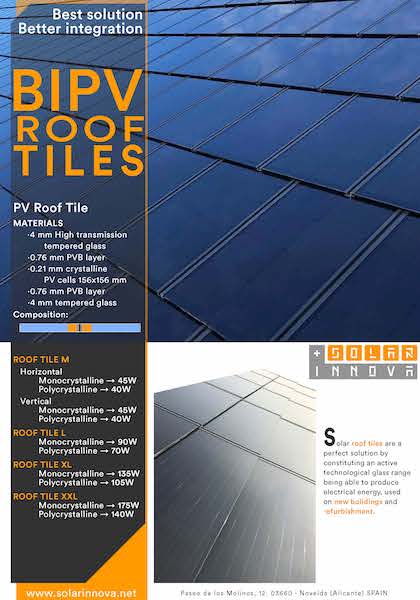
 ES
ES

 PT
PT