Catalogues
 Downloads
 Descrizione
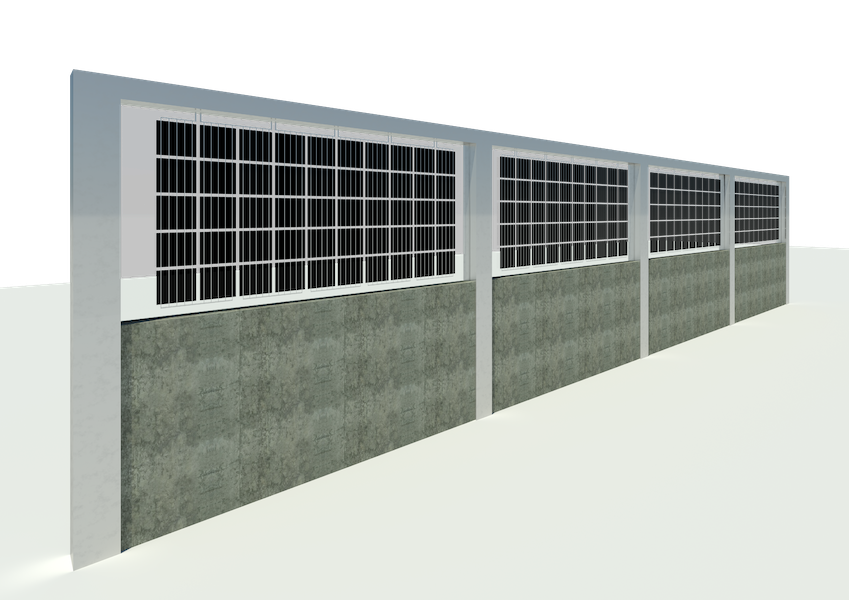
I pannelli solari vengono progettati sempre più pensando alla loro integrazione architettonica.
Le recinzioni solari sono una soluzione perfetta, poiché costituiscono una gamma di vetri tecnologici attivi che hanno la proprietà di generare energia elettrica e possono essere utilizzati sia nelle nuove costruzioni che nelle ristrutturazioni.
L'integrazione architettonica delle recinzioni fotovoltaiche nella costruzione, rende possibile la realizzazione di superfici vetrate che, oltre ad essere una novità estetica e funzionale, generano energia elettrica, consentendo l'autonomia elettrica con il conseguente risparmio energetico.
Solar Innova offre prodotti e soluzioni adatte alle esigenze del settore delle costruzioni e incorpora il design nell'energia solare, offrendo ad architetti e ingegneri la possibilità di unire l'impianto fotovoltaico all'estetica dell'edificio.
Le recinzioni fotovoltaiche Solar Innova possono essere installate sostituendo i materiali convenzionali.
Questo tipo di soluzioni sono perfette per essere utilizzate in ambienti urbani mantenendo l'estetica e rispettando il valore storico dell'ambiente.
Le nostre recinzioni soddisfano tutti i requisiti di sicurezza, sia flessibilità, doppio isolamento, o elevata resistenza ai raggi UV, lunghissima durata non avendo elementi che si degradano di fronte alle condizioni meteorologiche e/o ambientali, per tutti questi motivi. adatto per l'uso in applicazioni esterne.
 Materials
Solar Innova utilizza i materiali più recenti per produrre moduli fotovoltaici:
Glass

The front of the module contains a tempered solar glass with high transparency with high transmissivity, low reflectivity and low iron content.
The glass forms the front end of photovoltaic module and protects components housed within the laminate from the weather and mechanical stresses.
At the same time serves as carrier material in the lamination process.
A high transmittance increases the efficiency of the photovoltaic cells and thus has a direct influence on the potency and performance of the final module. A low iron content in the glass composition and an antireflection coating to reduce absorption of radiant energy.
Achieve excellent resistance against mechanical stress and temperature changes due to preload producer.
Top Encapsulant
EVA (Ethyl Vinyl Acetate)

The sheets of EVA (Ethyl Vinyl Acetate) are used to connect the solar cells through the lamination process with glass surface. This step provides the "encapsulated" solar module that is responsible for holding together the photovoltaic module and have a decisive bearing on life. The degree of chained EVA sheet after the lamination process is decisive for the quality indicator of the solar module.
An EVA sheet must guarantee insulation and protective effect throughout the life of the module. The films of poor quality can cause long-term discoloration, delamination or decomposition and, therefore, strongly impair the performance capability of the module in question. Solar Innova uses only high quality sheet of chains with a degree exceeding 85 %, thus providing long lasting protection of cells.
PVB (Polyvinyl Butyral)

The sheets of PVB (Polyvinyl Butyral) are used to connect the solar cells through the lamination process with glass surface. This step provides the "encapsulated" solar module that is responsible for holding together the photovoltaic module and have a decisive bearing on life. The degree of chained PVB sheet after the lamination process is decisive for the quality indicator of the solar module.
An PVB sheet must guarantee insulation and protective effect throughout the life of the module. The films of poor quality can cause long-term discoloration, delamination or decomposition and, therefore, strongly impair the performance capability of the module in question. Solar Innova uses only high quality sheet of chains with a degree exceeding 85 %, thus providing long lasting protection of cells.
The PVB used as encapsulant meets the highest security requirements against breakage resistance offering a break of more than 20 N/mm2.
Ribbon

Welding ribbon is specially designed for manufacturing solar panels product. It is used for electrical connections between solar photovoltaics.
It is made with a flat copper tape, coated with a thin layer of tin (414-600 microinches) on all sides. Tin copper confers protection against oxidation and provides a layer for easy welding.
The welding of the cells is performed by a combination of heat and pressure welding the longitudinal straps. The tape reaches the factory coils are placed in the automatic welding machines.
The solder coating on the ribbon interconnect provides 100% of that needed to form a reliable metallurgical bond at the top of the welding cells.
Cells


Solar cells directly convert sunlight into direct current electrical energy and the generator are of the module. The quality of cells directly influences the characteristics of a solar module is therefore essential silicon composition used.
Solar Innova cells used exclusively Innova highly efficient with minimal variations in the process of optimizing the production reproducibility of the separation of cells. Is a determining factor for the quality of the cell constant for stable profits. The high resistance multipliers and fill factors used cells provide a good source of energy radiation especially low.
Each cell is checked, and classified electrically calibrated prior to interconnection to optimize the behavior of the module.
Back Encapsulant
EVA (Ethyl Vinyl Acetate)
The sheets of EVA (Ethyl Vinyl Acetate) are used to connect the solar cells through the lamination process with glass surface. This step provides the "encapsulated" solar module that is responsible for holding together the photovoltaic module and have a decisive bearing on life. The degree of chained EVA sheet after the lamination process is decisive for the quality indicator of the solar module.
An EVA sheet must guarantee insulation and protective effect throughout the life of the module. The films of poor quality can cause long-term discoloration, delamination or decomposition and, therefore, strongly impair the performance capability of the module in question. Solar Innova uses only high quality sheet of chains with a degree exceeding 85 %, thus providing long lasting protection of cells.
PVB (Polyvinyl Butyral)
The sheets of PVB (Polyvinyl Butyral) are used to connect the solar cells through the lamination process with glass surface. This step provides the "encapsulated" solar module that is responsible for holding together the photovoltaic module and have a decisive bearing on life. The degree of chained PVB sheet after the lamination process is decisive for the quality indicator of the solar module.
An PVB sheet must guarantee insulation and protective effect throughout the life of the module. The films of poor quality can cause long-term discoloration, delamination or decomposition and, therefore, strongly impair the performance capability of the module in question. Solar Innova uses only high quality sheet of chains with a degree exceeding 85 %, thus providing long lasting protection of cells.
The PVB used as encapsulant meets the highest security requirements against breakage resistance offering a break of more than 20 N/mm2.
Glass
The back of the module contains a tempered solar glass with high transparency, low reflectivity and low iron content.
The glass forms the back end of photovoltaic module and protects components housed within the laminate from the weather and mechanical stresses.
At the same time serves as carrier material in the lamination process.
Achieve excellent resistance against mechanical stress and temperature changes due to preload producer.
Junction Box

The primary function is to transmit the energy produced in the module.
The junction box installed is made high temperature resistant plastics. The box is sealed and ready for the weather. Has a degree IP-65, which provides the insulation system against moisture, inclement weather, dirt and ultraviolet radiation. Inside are installed bypass diodes.
Bypass diodes protect the tensile modulus increased and consequently the so-called hot spot effects.
The modules are supplied with box and bypass diodes integrated.
In each module there is a single box for both terminals. Polarity must be observed in the connections to the proper functioning of the modules.
The junction box can be opened in case of failure, thereby facilitating an eventual replacement of damaged diodes. Covers of junction boxes have an indicative drawing. They open by inserting a screwdriver in the appropriate tab in the direction of the arrow, with light pressure on it to open. To close the lid, simply press it to closure. The lid has a flange attached to the junction box while handling the interior thereof. This flange must not be cut at all.
The junction boxes should not suffer any pressure when installing the module on a support structure. No element of it should touch the box.
The junction boxes are similar to modules with the same voltage rating. All connection boxes are provided with symmetrical cables of length 900 mm. With a connector positive (+) and a negative connector (-) with a working temperature range between - 40 ~ + 85° C.
Diodes

The shading of a cell can cause a reverse voltage on it. This cell thus consume power generated by the other in series, resulting in undesirable heating of the shaded cell. This effect, called hot spot will be greater the higher the radiation incident on the rest of the smaller cells and cell receiving that due to the shadow. In an extreme case the cell may be broken due to overheating.
The use of protective diodes or by-pass reduces the risk of heating of the shaded cells, limiting the current that can flow through them and thus preventing the breakage thereof.
All modules with a number of cells greater than or equal to 33 connected in series, manufactured by Solar Innova, are provided with protection diodes that are located at the junction boxes. In modules with fewer cells in series are not required the bypass diodes, as the hot spot effect does not reach the level of risk of rupture of the cells.
The replacement of bypass diodes should be performed only by a qualified competent photovoltaic after disconnecting the system module.
Cables

Our modules are fitted with flexible cables, symmetrical in length, with a diameter of copper section of 4 mm, weather resistant and have been specially designed and certified for use in our modules. Have high values of electrical safety and fire resistance. Its insulation to weathering and UV rays ensures longevity of the installation. Furthermore, the wide range of temperature allows its application even in extreme climatic areas, preventing heat aging and therefore allowing a long life in the photovoltaic system. They have a high strength and a very low contact resistance, all designed to obtain minimum voltage drop losses and allows them to continue operating even in unfavorable conditions.
All our photovoltaic modules are supplied with cable assemblies in the box with the following features:
Length: 900 mm.
Operating Temperature Range: - 40 ~ + 90° C.
Connectors

Our PV modules are equipped with connectors and sockets MC-T4 100 % compatible with the connectors and sockets used to connect electrical systems. Only MC-T4 connector or compatible and special solar cables may be used to lengthen the cables connected to the module. These must meet the electrical requirements of the Interconnection design.
All our photovoltaic modules are supplied with assembled connectors on cables with the following features:
Diameter: Ø 4 mm.
Maximum rated current: 30 A.
Maximum system voltage: 1000 V.
Plugged Protection level: IP-67.
Mounting: easy.
Locking system: Snap in.
Protection Class: II.
Operating Temperature Range: - 40 ~ + 90° C.
Sealed

PV modules require the use of silicone sealant high quality for bonding and sealing of junction boxes of photovoltaic modules.
Silicone has excellent adhesion to most substrates used in the manufacture of photovoltaic modules and does not lose its flexibility in a wide temperature range so it offers perfect protection against the ingress of water into the laminate.
Fabricated with high efficiency. No chemical reactions with EVA material and PVF film protector ensures the chemical stability.
The silicone is applied in the grooves of the frame and the edge of the laminate so as to prevent any infiltration of gas or liquid that can erode the module. At the same time, elasticity serves as a protection against possible mechanical impacts during installation or handling.
Labels

This document describes data sheet and nameplate information for non-concentrating photovoltaic modules. The intent is to provide minimum information required to configure a safe and optimal system with photovoltaic modules. In this context, data sheet information is a technical description separate from the photovoltaic module. The nameplate is a sign in durable construction in the photovoltaic module.

This document is used for identification and traceability at each stage of the production process as part of quality control.
 Produzione
Ogni modulo fotovoltaico è costituito da un insieme di celle solari interconnesse elettricamente, incapsulate insieme ad altri materiali che rendono il tutto resistente alle condizioni atmosferiche, con un design robusto e facile da installare. Le fasi principali del processo di produzione sono riassunte brevemente di seguito:


3.- Interconnessione cellulare

Saldatura cellule è uno dei passi fondamentali del processo di fabbricazione di un modulo fotovoltaico.
Saldare le celle solari in stringhe di celle si effettua collegando la parte anteriore di una cella con la parte posteriore della cella successiva da strisce metalliche che raccolgono e conducono l'elettricità attraverso la stringa o la catena di celle fotovoltaiche.
Le saldatrici celle Solar Innova consentono alle cellule di saldatura di diverse dimensioni e tipologie (dimensione, lo spessore, il numero di sbarre, silicio monocristalino o policristallino).
4.- Disposizione

Nella parte anteriore è collocato vetro temperato per evitare il deterioramento delle fotocellule.
Dopo il foglio protettivo con cui è posizionato il fronte EVA o PVB delle cellule saranno incapsulati.
È sequenzialmente procede posizionare tutte le stringhe lasciando lo stesso spazio tra ciascuna di esse. Una volta posizionati tutti questi fili sono saldati insieme.
Questa importanza guadagni passo quando si è automatizzato per limitare le sollecitazioni sulle cellule e saldature stringa per massimizzare la produttività e ridurre il tasso di rottura del modulo.
Successivamente, il seguente foglio di EVA o PVB protettivo con cui sono posti sul retro delle cellule incapsulate.
Nella parte posteriore è collocato vetro temperato per evitare il deterioramento delle fotocellule.

6.- Laminazione/Cotto

Il sandwich è stato introdotto in autoclave (forno caldo), chiuso ermeticamente ad una temperatura di 145-150º Celsius e una pressione tra il 10,5 a 11,5 bar durante due fasi di due ore, per formare un'unità robusta per tempo, al fine di sigillare i vari strati del modulo tramite pressione e temperatura.
Una volta al forno è proceduto a tagliare il materiale in eccesso (EVA o PVB) ai bordi del laminato.


11.- Prova di Flash

L'apparecchiatura di prova del flash è un controllo di qualità essenziale in una linea di produzione di moduli solari.
Tutti i nostri moduli sono introdotti in un simulatore solare per testare loro attraverso un voltmetro con cui viene verificato se la curva di corrente-tensione sia corretta.
Il flash test è un test per misurare le prestazioni di un modulo fotovoltaico ed è un metodo standard con cui garantire il funzionamento di ciascun modulo. Durante questa prova moduli fotovoltaici sono esposti a un lampo di luce (1 ms a 30 ms), leggero (100 mW per cm2) da ARC luce della lampada allo xeno. La luce spettro di questa lampada sia il più vicino possibile allo spettro solare.
Al fine di garantire la precisione della misurazione, Solar Innova utilizza un modulo di posizionamento del piano e perfettamente orientato a Flash illuminazione è uniforme su tutta la superficie del modulo.
I dati vengono raccolti da un computer e sono confrontati con i dati di un modulo fotovoltaico in un laboratorio di riferimento calibrato.
I risultati del test vengono confrontati in flash lenzuola tecniche e moduli di dati sono incorporati nei rapporti di prova e stampati su specifiche etichette.
12.- Etichettatura

Una volta che le misurazioni effettuate ogni modulo saranno segnate sul retro con un adesivo ben visibile e indelebile in cui si riflettono i dati del produttore, modello e dettagli tecnici di ogni modulo, il tutto in conformità alla norma EN 50380:2003, le informazioni dai dati fogli e targhe per i moduli fotovoltaici.
I moduli sono etichettati sulla parte posteriore con un codice a barre contenente un numero di serie riconducibili alla data di produzione per l'identificazione.


 EN
EN ES
ES PT
PT