βίντεό
 Catalogues
 Κατέβηκες
 Περιγραφή

Οι ηλιακοί συλλέκτες σχεδιάζονται όλο και περισσότερο για την αρχιτεκτονική τους ολοκλήρωση. Τα ηλιακά πλακάκια είναι μια τέλεια λύση, καθώς αποτελούν μια σειρά από ενεργά τεχνολογικά γυαλιά που έχουν την ιδιότητα να παράγουν ηλεκτρική ενέργεια και μπορούν να χρησιμοποιηθούν τόσο σε νέα κτίρια όσο και σε ανακαινίσεις.
Η αρχιτεκτονική ενσωμάτωση των φωτοβολταϊκών πλακιδίων στην κατασκευή, καθιστά δυνατή τη δημιουργία γυάλινων επιφανειών που εκτός από την αισθητική και τη λειτουργική πρωτοτυπία, παράγουν ηλεκτρική ενέργεια, επιτρέποντας την ηλεκτρική αυτονομία με επακόλουθη εξοικονόμηση ενέργειας.
Η Solar Innova προσφέρει προϊόντα και λύσεις προσαρμοσμένες στις ανάγκες του κατασκευαστικού τομέα και ενσωματώνει σχεδιασμό στην ηλιακή ενέργεια, παρέχοντας στους αρχιτέκτονες και τους μηχανικούς τη δυνατότητα να ενταχθούν στην φωτοβολταϊκή εγκατάσταση στην αισθητική του κτιρίου.
Τα φωτοβολταϊκά πλακάκια της Solar Innova μπορούν να εγκατασταθούν σε επίπεδες στέγες, αντικαθιστώντας τα συμβατικά υλικά.
Αυτός ο τύπος λύσεων είναι ιδανικός για χρήση σε αστικά περιβάλλοντα, διατηρώντας την αισθητική και σεβασμό της ιστορικής αξίας του περιβάλλοντος.
Τα κεραμίδια μας πληρούν όλες τις απαιτήσεις ασφαλείας, τόσο ευκαμψία, διπλή μόνωση, είτε υψηλή αντοχή στις υπεριώδεις ακτίνες, πολύ μεγάλη ανθεκτικότητα, επειδή δεν έχουν στοιχεία που υποβαθμίζονται σε σχέση με τις καιρικές συνθήκες και / ή τις περιβαλλοντικές συνθήκες, για όλους αυτούς τους λόγους. κατάλληλο για χρήση σε υπαίθριες εφαρμογές.
 Materials
Η Solar Innova χρησιμοποιεί τα πιο σύγχρονα υλικά για την κατασκευή φωτοβολταϊκών μονάδων:
Glass

The front of the module contains a tempered solar glass with high transparency with high transmissivity, low reflectivity and low iron content.
The glass forms the front end of photovoltaic module and protects components housed within the laminate from the weather and mechanical stresses.
At the same time serves as carrier material in the lamination process.
A high transmittance increases the efficiency of the photovoltaic cells and thus has a direct influence on the potency and performance of the final module. A low iron content in the glass composition and an antireflection coating to reduce absorption of radiant energy.
Achieve excellent resistance against mechanical stress and temperature changes due to preload producer.
Top Encapsulant
EVA (Ethyl Vinyl Acetate)

The sheets of EVA (Ethyl Vinyl Acetate) are used to connect the solar cells through the lamination process with glass surface. This step provides the "encapsulated" solar module that is responsible for holding together the photovoltaic module and have a decisive bearing on life. The degree of chained EVA sheet after the lamination process is decisive for the quality indicator of the solar module.
An EVA sheet must guarantee insulation and protective effect throughout the life of the module. The films of poor quality can cause long-term discoloration, delamination or decomposition and, therefore, strongly impair the performance capability of the module in question. Solar Innova uses only high quality sheet of chains with a degree exceeding 85 %, thus providing long lasting protection of cells.
PVB (Polyvinyl Butyral)

The sheets of PVB (Polyvinyl Butyral) are used to connect the solar cells through the lamination process with glass surface. This step provides the "encapsulated" solar module that is responsible for holding together the photovoltaic module and have a decisive bearing on life. The degree of chained PVB sheet after the lamination process is decisive for the quality indicator of the solar module.
An PVB sheet must guarantee insulation and protective effect throughout the life of the module. The films of poor quality can cause long-term discoloration, delamination or decomposition and, therefore, strongly impair the performance capability of the module in question. Solar Innova uses only high quality sheet of chains with a degree exceeding 85 %, thus providing long lasting protection of cells.
The PVB used as encapsulant meets the highest security requirements against breakage resistance offering a break of more than 20 N/mm2.
Ribbon

Welding ribbon is specially designed for manufacturing solar panels product. It is used for electrical connections between solar photovoltaics.
It is made with a flat copper tape, coated with a thin layer of tin (414-600 microinches) on all sides. Tin copper confers protection against oxidation and provides a layer for easy welding.
The welding of the cells is performed by a combination of heat and pressure welding the longitudinal straps. The tape reaches the factory coils are placed in the automatic welding machines.
The solder coating on the ribbon interconnect provides 100% of that needed to form a reliable metallurgical bond at the top of the welding cells.
Cells


Solar cells directly convert sunlight into direct current electrical energy and the generator are of the module. The quality of cells directly influences the characteristics of a solar module is therefore essential silicon composition used.
Solar Innova cells used exclusively Innova highly efficient with minimal variations in the process of optimizing the production reproducibility of the separation of cells. Is a determining factor for the quality of the cell constant for stable profits. The high resistance multipliers and fill factors used cells provide a good source of energy radiation especially low.
Each cell is checked, and classified electrically calibrated prior to interconnection to optimize the behavior of the module.
Back Encapsulant
EVA (Ethyl Vinyl Acetate)
The sheets of EVA (Ethyl Vinyl Acetate) are used to connect the solar cells through the lamination process with glass surface. This step provides the "encapsulated" solar module that is responsible for holding together the photovoltaic module and have a decisive bearing on life. The degree of chained EVA sheet after the lamination process is decisive for the quality indicator of the solar module.
An EVA sheet must guarantee insulation and protective effect throughout the life of the module. The films of poor quality can cause long-term discoloration, delamination or decomposition and, therefore, strongly impair the performance capability of the module in question. Solar Innova uses only high quality sheet of chains with a degree exceeding 85 %, thus providing long lasting protection of cells.
PVB (Polyvinyl Butyral)
The sheets of PVB (Polyvinyl Butyral) are used to connect the solar cells through the lamination process with glass surface. This step provides the "encapsulated" solar module that is responsible for holding together the photovoltaic module and have a decisive bearing on life. The degree of chained PVB sheet after the lamination process is decisive for the quality indicator of the solar module.
An PVB sheet must guarantee insulation and protective effect throughout the life of the module. The films of poor quality can cause long-term discoloration, delamination or decomposition and, therefore, strongly impair the performance capability of the module in question. Solar Innova uses only high quality sheet of chains with a degree exceeding 85 %, thus providing long lasting protection of cells.
The PVB used as encapsulant meets the highest security requirements against breakage resistance offering a break of more than 20 N/mm2.
Glass
The back of the module contains a tempered solar glass with high transparency, low reflectivity and low iron content.
The glass forms the back end of photovoltaic module and protects components housed within the laminate from the weather and mechanical stresses.
At the same time serves as carrier material in the lamination process.
Achieve excellent resistance against mechanical stress and temperature changes due to preload producer.
Junction Box

The primary function is to transmit the energy produced in the module.
The junction box installed is made high temperature resistant plastics. The box is sealed and ready for the weather. Has a degree IP-65, which provides the insulation system against moisture, inclement weather, dirt and ultraviolet radiation. Inside are installed bypass diodes.
Bypass diodes protect the tensile modulus increased and consequently the so-called hot spot effects.
The modules are supplied with box and bypass diodes integrated.
In each module there is a single box for both terminals. Polarity must be observed in the connections to the proper functioning of the modules.
The junction box can be opened in case of failure, thereby facilitating an eventual replacement of damaged diodes. Covers of junction boxes have an indicative drawing. They open by inserting a screwdriver in the appropriate tab in the direction of the arrow, with light pressure on it to open. To close the lid, simply press it to closure. The lid has a flange attached to the junction box while handling the interior thereof. This flange must not be cut at all.
The junction boxes should not suffer any pressure when installing the module on a support structure. No element of it should touch the box.
The junction boxes are similar to modules with the same voltage rating. All connection boxes are provided with symmetrical cables of length 900 mm. With a connector positive (+) and a negative connector (-) with a working temperature range between - 40 ~ + 85° C.
Diodes

The shading of a cell can cause a reverse voltage on it. This cell thus consume power generated by the other in series, resulting in undesirable heating of the shaded cell. This effect, called hot spot will be greater the higher the radiation incident on the rest of the smaller cells and cell receiving that due to the shadow. In an extreme case the cell may be broken due to overheating.
The use of protective diodes or by-pass reduces the risk of heating of the shaded cells, limiting the current that can flow through them and thus preventing the breakage thereof.
All modules with a number of cells greater than or equal to 33 connected in series, manufactured by Solar Innova, are provided with protection diodes that are located at the junction boxes. In modules with fewer cells in series are not required the bypass diodes, as the hot spot effect does not reach the level of risk of rupture of the cells.
The replacement of bypass diodes should be performed only by a qualified competent photovoltaic after disconnecting the system module.
Cables

Our modules are fitted with flexible cables, symmetrical in length, with a diameter of copper section of 4 mm, weather resistant and have been specially designed and certified for use in our modules. Have high values of electrical safety and fire resistance. Its insulation to weathering and UV rays ensures longevity of the installation. Furthermore, the wide range of temperature allows its application even in extreme climatic areas, preventing heat aging and therefore allowing a long life in the photovoltaic system. They have a high strength and a very low contact resistance, all designed to obtain minimum voltage drop losses and allows them to continue operating even in unfavorable conditions.
All our photovoltaic modules are supplied with cable assemblies in the box with the following features:
Length: 900 mm.
Operating Temperature Range: - 40 ~ + 90° C.
Connectors

Our PV modules are equipped with connectors and sockets MC-T4 100 % compatible with the connectors and sockets used to connect electrical systems. Only MC-T4 connector or compatible and special solar cables may be used to lengthen the cables connected to the module. These must meet the electrical requirements of the Interconnection design.
All our photovoltaic modules are supplied with assembled connectors on cables with the following features:
Diameter: Ø 4 mm.
Maximum rated current: 30 A.
Maximum system voltage: 1000 V.
Plugged Protection level: IP-67.
Mounting: easy.
Locking system: Snap in.
Protection Class: II.
Operating Temperature Range: - 40 ~ + 90° C.
Sealed

PV modules require the use of silicone sealant high quality for bonding and sealing of junction boxes of photovoltaic modules.
Silicone has excellent adhesion to most substrates used in the manufacture of photovoltaic modules and does not lose its flexibility in a wide temperature range so it offers perfect protection against the ingress of water into the laminate.
Fabricated with high efficiency. No chemical reactions with EVA material and PVF film protector ensures the chemical stability.
The silicone is applied in the grooves of the frame and the edge of the laminate so as to prevent any infiltration of gas or liquid that can erode the module. At the same time, elasticity serves as a protection against possible mechanical impacts during installation or handling.
Labels

This document describes data sheet and nameplate information for non-concentrating photovoltaic modules. The intent is to provide minimum information required to configure a safe and optimal system with photovoltaic modules. In this context, data sheet information is a technical description separate from the photovoltaic module. The nameplate is a sign in durable construction in the photovoltaic module.

This document is used for identification and traceability at each stage of the production process as part of quality control.
 Παραγωγή
Κάθε φωτοβολταϊκή μονάδα αποτελείται από ένα σύνολο ηλεκτρικά διασυνδεδεμένων ηλιακών κυψελών, ενθυλακωμένα μαζί με άλλα υλικά που καθιστούν το σύνολο ανθεκτικό στις ατμοσφαιρικές συνθήκες, με στιβαρή σχεδίαση και εύκολη εγκατάσταση. Τα κύρια στάδια της παραγωγικής διαδικασίας συνοψίζονται εν συντομία:


3.- διασύνδεση κύτταρα

Συγκόλληση κυττάρων είναι ένα από τα βασικά στάδια της διαδικασίας κατασκευής ενός φωτοβολταϊκού ηλιακού συλλέκτη.
Συγκόλληση των ηλιακών κυττάρων σε κυτταρικές αλυσίδες (χορδές) εκτελείται με τη σύνδεση του εμπρόσθια όψη ενός κυττάρου με την πίσω πλευρά της επόμενης στοιχείο μέσω μεταλλικών λωρίδων που συλλέγουν και διεξάγει ηλεκτρικής ενέργειας μέσω της στοιχειοσειράς ή αλυσίδα κυττάρων φωτοβολταϊκά.
Μηχανές συγκόλλησης Ηλιακό Solar Innova συγκόλλησης επιτρέπουν στα κύτταρα διαφορετικών τύπων και διαστάσεων (ύψος, πάχος, ο αριθμός των ζυγών, μονοκρυσταλλικού ή πολυκρυσταλλικού πυριτίου).
4.- Διάταξη

Στο γυαλί μπροστά στην πρόληψη της υποβάθμισης των φωτοκύτταρα τοποθετείται.
Μετά το προστατευτικό φύλλο με το οποίο είναι τοποθετημένο το εμπρόσθιο EVA των κυττάρων θα εκφράζεται.
Είναι διαδοχικά προχωρά να τοποθετήσετε όλες τις χορδές αφήνοντας το ίδιο διάστημα μεταξύ κάθε μία από αυτές. Τα Μόλις τοποθετηθούν όλα αυτά τα χορδές συγκολλούνται μεταξύ τους.
Αυτό το βήμα αποκτά μεγαλύτερη σημασία όταν είναι αυτοματοποιημένη για να περιορίσει τάσεις στα κύτταρα και συγκολλήσεις string για να μεγιστοποιήσει την παραγωγικότητα και να μειωθεί το ποσοστό θραύση μονάδα.
Στη συνέχεια, ο ακόλουθος προστατευτικό φύλλο EVA με την οποία η πλάτη των ενθυλακωμένων κυττάρων τοποθετούνται.
Στο πίσω γυαλί για να αποτραπεί η επιδείνωση των φωτοκύτταρα τοποθετείται.

6.- Σφυρηλάτηση προς φύλλωση / Ψητό

Το σάντουιτς εισήχθη σε ένα αυτόκλειστο (ζεστό φούρνο), ερμητικά σφραγισμένο σε θερμοκρασία 145-150º Κελσίου και πίεση μεταξύ 10,5 έως 11,5 bar κατά την διάρκεια δύο φάσεων από δύο ώρες, για να σχηματίσει ένα τραχύ μονάδα να καιρικές συνθήκες, ώστε να σφραγίσει τα διάφορα στρώματα της μονάδας μέσω πίεσης και θερμοκρασίας.
Μόλις ψηθούν είναι προχώρησε για να κοπεί το πλεονάζον υλικό (EVA ή PVB) στα άκρα του ελάσματος.


11.- Λάμψη Δοκιμή

Ο εξοπλισμός δοκιμής φλας είναι ένα ουσιαστικό έλεγχο της ποιότητας σε μια γραμμή παραγωγής των ηλιακών συλλεκτών.
Όλες οι μονάδες μας εισήγαγε σε ένα ηλιακό προσομοιωτή για να τα δοκιμάσετε μέσα από ένα βολτόμετρο με την οποία ελέγχεται εάν η καμπύλη ρεύματος-τάσης είναι σωστή.
Η δοκιμή φλας είναι ένα τεστ για τη μέτρηση της επίδοσης μιας ηλιακής φωτοβολταϊκής μονάδας και είναι μια τυπική διαδικασία σε κατασκευαστή για να εξασφαλιστεί η λειτουργικότητα του κάθε ενότητα. Κατά τη διάρκεια μιας δοκιμής flash η φωτοβολταϊκή μονάδα εκτίθεται σε ένα σύντομο (1 ms έως 30 ms), φωτεινή (100 mW ανά τετρ. Εκατοστά) λάμψη φωτός από ένα ξένο συμπληρώθηκε λυχνία τόξου. Το φάσμα εξόδου του φανού αυτού είναι όσο πιο κοντά στο φάσμα του ήλιου όσο το δυνατόν.
Για να εξασφαλιστεί η ακρίβεια της μέτρησης, χρησιμοποιούμε μια μονάδα αεροπλάνο τοποθέτηση και τέλεια προσανατολισμένη σε flash φωτισμού είναι ομοιόμορφη σε όλη την επιφάνεια της μονάδας.
Η έξοδος συλλέγεται με έναν υπολογιστή και τα δεδομένα σε σύγκριση με μια ηλιακή μονάδα αναφοράς. Τα στοιχεία αναφοράς είναι προσανατολισμένη προς την ισχύ εξόδου βαθμονομηθεί με το πρότυπο ηλιακή ακτινοβολία.
Τα αποτελέσματα των δοκιμών σε σύγκριση flash φύλλα τεχνικές και λειτουργικές μονάδες δεδομένα που περιλαμβάνονται στις εκθέσεις δοκιμών και έντυπα σχετικά με τις προδιαγραφές ετικέτες.
12.- Τιτλοφόρηση

Μόλις οι μετρήσεις που λαμβάνονται κάθε ενότητα θα φέρει την ένδειξη στο πίσω μέρος με τρόπο ευκρινή και ανεξίτηλο αυτοκόλλητο όπου τα στοιχεία του κατασκευαστή, το μοντέλο και τις τεχνικές λεπτομέρειες της κάθε ενότητας αντικατοπτρίζονται, όλα σύμφωνα με το πρότυπο EN 50380: 2003, πληροφορίες από τα δεδομένα φύλλα και πινακίδες για φωτοβολταϊκά στοιχεία.
Τα δομοστοιχεία φέρουν ετικέτα στην πλάτη με γραμμωτό κώδικα που περιέχει σειριακό αριθμό που μπορεί να ανιχνευθεί μέχρι την ημερομηνία κατασκευής για αναγνώριση.


 EN
EN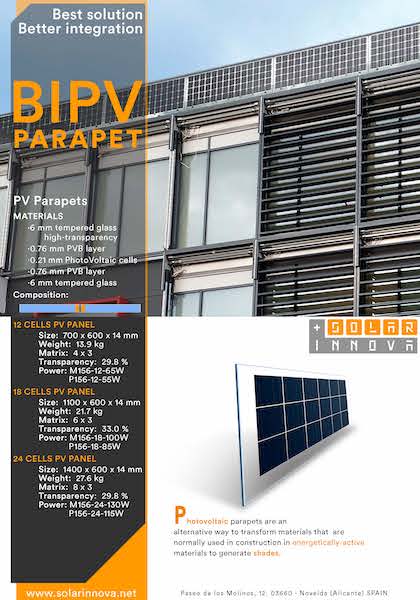
 ES
ES

 PT
PT